Lymph Tonic is a liquid supplement promoted to support lymphatic drainage, circulation and healthy fluid balance. So, does Lymph Tonic really work? I looked beyond the testimonials and checked the Supplement Facts label, the individual ingredients and human research involving swelling and lymphatic function. Some ingredients are more interesting than I expected. I also found something unusual: one Lymph Tonic sales page describes a different formula from the 13 ingredients shown on the current Supplement Facts label. Here’s what I think you should know before deciding whether Lymph Tonic is worth trying. Affiliate disclosure: This review contains affiliate links. If you purchase Lymph Tonic through one of these links, I may earn a commission at no additional cost to you. This does not influence my conclusions.
Quick Answer: Does Lymph Tonic Work?
There isn’t enough evidence yet to know if the finished Lymph Tonic supplement works. I could not locate a published clinical trial testing Lymph Tonic itself. That said, I wouldn’t dismiss all of its ingredients.
Horse chestnut has human evidence showing reductions in leg swelling associated with chronic venous insufficiency. Even more interesting, hesperidin compounds have been studied directly for lymphatic function and lymphedema. The main issue is dosage.
Lymph Tonic contains 13 active ingredients sharing one 600 mg proprietary blend, which makes it difficult to know whether the amounts are similar to those used in clinical research.
Check Lymph Tonic Price & 60-Day Guarantee
What Is Lymph Tonic?
Lymph Tonic is an alcohol-free liquid dietary supplement sold for lymphatic and circulation support.
According to the current product information:
- Serving size: 2 droppers
- Servings per bottle: 30
- Bottle size: 2 fl oz (59 mL)
- Active blend: 600 mg
- Active ingredients: 13
The company says Lymph Tonic is manufactured in the United States, contains no artificial preservatives, and is third-party tested for purity.
It would be nice to see the actual Certificate of Analysis or testing report, which are not listed on the website.
Lymph Tonic Ingredients: What’s Really in It?
The Supplement Facts panel lists 13 ingredients in a 600 mg proprietary blend.
They appear in this order:
- Boswellia serrata extract
- Baicalein
- Omega-3 fatty acids
- Curcumin
- Hesperidin methyl chalcone
- Horse chestnut extract
- Gotu kola extract
- Nattokinase
- Quercetin phytosome
- Ginger extract
- Black pepper extract
- Phosphatidylcholine
- D-alpha tocopherol, a form of vitamin E
The serving size is two droppers
Omega-3 fatty acids are important to include here because they are the third ingredient in the blend. That tells us something useful about the possible dose.
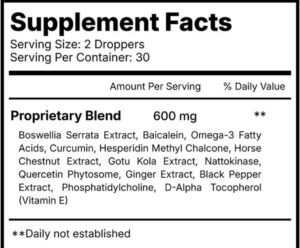
Lymph Tonic Supplement Facts label reviewed for this article
How Much of Each Ingredient Is in Lymph Tonic?
Lymph Tonic provides 600 mg of 13 active ingredients, but because they are listed as a proprietary blend, the label doesn’t reveal the amount of each ingredient.
That might matter because clinical studies normally use specific amounts. Without knowing the individual doses, it’s difficult to tell whether Lymph Tonic provides amounts similar to those used in research.
We can get a few clues from the ingredient order. FDA labeling rules require ingredients in a proprietary blend to be listed in descending order by weight.
For example:
- Omega-3 fatty acids, the third ingredient, cannot exceed about 200 mg of the 600 mg blend.
- Hesperidin methyl chalcone, fifth, cannot exceed about 120 mg.
- Horse chestnut, sixth, cannot exceed about 100 mg.
This doesn’t mean Lymph Tonic is underdosed or won’t work. It simply means the proprietary blend prevents us from comparing its ingredient amounts directly with those used in clinical studies.
Which Lymph Tonic Ingredients Have the Best Evidence?
Here’s how I rate the evidence most relevant to the reason people would buy Lymph Tonic.
| Ingredient | What Human Research Suggests | How Relevant Is It to Lymph Tonic? |
|---|---|---|
| Hesperidin compounds | Have been studied for lymphatic circulation and in a combination treatment for secondary lymphedema | Highly relevant because Lymph Tonic contains hesperidin methyl chalcone |
| Horse chestnut | Has fairly good evidence for reducing leg swelling caused by chronic venous insufficiency | Relevant, although venous swelling is not the same as lymphedema |
| Omega-3 fatty acids | Extensively studied for cardiovascular and inflammatory effects | Less direct because good evidence for improving lymphatic drainage is lacking |
| Curcumin | Has considerable human research involving inflammation | Plausible, but not proven to reduce lymphedema |
| Boswellia | Has human anti-inflammatory research | Plausible, but direct lymphatic evidence is limited |
The two ingredients I find most interesting for Lymph Tonic are hesperidin methyl chalcone and horse chestnut. They have human research that is more closely related to swelling or lymphatic function than the other ingredients.
That does not prove Lymph Tonic works. But it does give the formula more scientific rationale than a supplement made entirely from ingredients with no relevant human research.
Hesperidin and Lymphatic Function: New 2026 Human Research
What About Omega-3 Fatty Acids in Lymph Tonic?
Omega-3 fatty acids are one of the better-known ingredients in Lymph Tonic. They have extensive human research involving heart health and inflammation, so including them in the formula is reasonable.
What I could not find is good human evidence showing that omega-3 supplements directly improve lymphatic drainage or treat lymphedema.
Dosage is another question. Omega-3 fatty acids are the third ingredient in Lymph Tonic’s 600 mg proprietary blend.
One thing I would like to see is the EPA/DHA makeup of the omega-3 fatty acids. That’s what’s often measured in clinical research. Knowing the amount of EPA and DHA would make it easier to evaluate this part of the formula.
What Does the Stanford LTB4 Research Really Show?
Lymph Tonic marketing refers to Stanford research involving leukotriene B4, or LTB4, an inflammatory molecule that appears to play a role in lymphedema.
The research itself is legit.
In a 2017 study, researchers found that high levels of LTB4 interfered with lymphatic repair. In mice with experimental lymphedema, blocking LTB4 reduced swelling, improved lymphatic function and restored lymphatic vessel structure.
That makes LTB4 an interesting target for future lymphedema treatments.
Researchers later studied ketoprofen, an anti-inflammatory drug that can affect the LTB4 pathway, in people with lymphedema.
Ketoprofen significantly improved skin thickness and microscopic signs of inflammation. However, it did not significantly reduce limb volume.
The Stanford researchers did not test Lymph Tonic, and these studies do not show that the ingredients in Lymph Tonic block LTB4 strongly enough to produce the same effects.
Bottom line: The Stanford research supports the idea that inflammation and LTB4 may play an important role in lymphedema. But it does not prove that Lymph Tonic affects this pathway enough to reduce lymphedema in people.
Why Does Lymph Tonic Show Different Ingredients?
While researching Lymph Tonic, I found a separate website (LymphTonic.com) that describes a different formula from the current Supplement Facts label I am reviewing here.
The current label lists 13 ingredients in a 600 mg proprietary blend
The LymphTonic.com site describes 12 ingredients, including diosmin and bromelain, which are not on the label I’m reviewing. It also says there are no proprietary blends.
Why the difference? I don’t know. The alternate website may contain an older or proposed formula that was never updated. Because TryLymphTonic.com appears to be the current product site, I’m using its Supplement Facts label throughout this review.
I would still like to see the company clarify why the two ingredient descriptions are different.
Lymph Tonic Claims: What Does the Evidence Show?
| Lymph Tonic Claim | What I Found |
|---|---|
| Supports lymphatic function | Some ingredient research makes this plausible, particularly research involving hesperidin |
| Helps reduce swelling | Horse chestnut has human evidence for some types of leg swelling, but Lymph Tonic itself hasn’t been tested |
| Supports circulation | Several ingredients, including horse chestnut and hesperidin, have relevant human research |
| 94% success rate | I could not locate a published Lymph Tonic study supporting this number |
| 4–6 inches of circumference reduction | I could not locate clinical evidence showing this is a typical Lymph Tonic result |
| 15–40 pounds of fluid loss | I could not locate published evidence supporting this amount of fluid loss |
| Regenerates lymphatic vessels | Interesting experimental research exists, but this has not been demonstrated for Lymph Tonic in people |
Do Compression Stockings Work for Lymphedema?
One page of the Lymph Tonic website suggests that compression stockings don’t work. I think that statement gives people the wrong impression.
Compression garments are a standard part of lymphedema management. The National Cancer Institute says they can help reduce fluid buildup, prevent lymphatic fluid from flowing backward, and help muscle contractions move fluid through the lymphatic system.
That doesn’t mean compression stockings cure lymphedema. They can help control swelling rather than repair the underlying lymphatic damage.
Bottom line: Compression isn’t a cure, but saying compression stockings simply “don’t work” goes too far. I would not stop medically recommended compression therapy because you’re trying Lymph Tonic.
Lymph Tonic Side Effects: Is It Safe?
I could not locate a clinical trial of Lymph Tonic itself, so we don’t have good data showing how often side effects occur with the supplement.
On the plus side, most of its ingredients are used in dietary supplements, but that doesn’t necessarily mean side effects or drug interactions are impossible.
One ingredient I would pay particular attention to is nattokinase, an enzyme derived from fermented soybeans. Nattokinase can affect the processes involved in breaking down blood clots. There is also a published case report of a brain hemorrhage in a person who took nattokinase while using aspirin, although a single case cannot tell us how common this might be.
Who Should Check With a Doctor Before Taking Lymph Tonic?
Talk with a healthcare professional before using Lymph Tonic if you:
- Take a blood thinner or antiplatelet medication, including daily aspirin
- Have a bleeding or clotting disorder
- Are scheduled for surgery
- Are pregnant or breastfeeding
- Take medications that could potentially interact with herbal supplements
Bottom line: Most healthy adults may not have an obvious reason to avoid Lymph Tonic, but people who take medications that affect blood clotting should be especially careful.
Who Might Want to Try Lymph Tonic?
I can understand why some people may still want to try Lymph Tonic.
It may appeal to someone who:
- Prefers a liquid supplement instead of capsules
- Is interested in ingredients such as hesperidin, horse chestnut, curcumin, and boswellia
- Understands that research on individual ingredients does not prove that Lymph Tonic itself works
- Has realistic expectations about the results
- Is not planning to replace medically recommended lymphedema treatment
- Likes having a 60-day money-back guarantee if the product does not meet expectations
I think the best way to look at Lymph Tonic is as a supplement with some interesting ingredients and limited evidence for the finished formula.
You don’t have to believe every claim on the sales page to decide that it is worth trying.
If you’ve reviewed the evidence and want to see how you personally respond, you can check the current price and guarantee below.
Check Lymph Tonic Price & 60-Day Guarantee
Affiliate link. I may earn a commission at no additional cost to you.
How Much Does Lymph Tonic Cost?
At the time of this review, Lymph Tonic was sold in three price options:
| Supply | Price | Price Per Bottle |
| 2 months | $158 | $79 |
| 3 months | $207 | $69 |
| 6 months | $294 | $49 |
The six-month package has the lowest cost per bottle, saving $30 per bottle compared with the two-month option. It also requires the largest upfront purchase.
If you’re trying Lymph Tonic for the first time, the decision comes down to whether you prefer a lower upfront cost or the lower price per bottle of the larger package.
Prices and promotions can change, so check the current offer before ordering.
Check Current Lymph Tonic Price
Affiliate link. I may earn a commission at no additional cost to you.
Lymph Tonic 60-Day Guarantee: What You Should Know
Lymph Tonic comes with a 60-day money-back guarantee. If you try the product and aren’t satisfied, you can request a refund
There are a few details worth knowing when you order:
- The 60 days begin from the date of purchase, not the date you receive the product.
- You must contact Lymph Tonic customer support before returning your order.
- You need to return all bottles, including opened or empty bottles.
- You are responsible for return shipping costs
- Shipping and handling charges may be deducted from your refund.
- The guarantee can only be used once. If you get a refund and purchase Lymph Tonic again, the second purchase is not eligible for another refund.
Lymph Tonic recommends taking the supplement for at least two months, yet the refund period begins on the day you purchase it. Since shipping takes time, you won’t actually have a full 60 days of using the product before the guarantee expires.
Is Lymph Tonic Legit or a Scam?
I would not call Lymph Tonic a scam based on what I found.
What I Like About Lymph Tonic
- Some ingredients have relevant human research
- Hesperidin methyl chalcone is interesting because it has appeared in human research involving lymphedema.
- The formula contains several well-studied ingredients, including omega-3 fatty acids, curcumin, boswellia, and ginger.
- It does not contain alcohol.
- It’s a liquid supplement that some people may prefer over capsules.
- No autoshipments. When you run out, order it again when you prefer.
Overall, Lymph Tonic has a more interesting ingredient rationale than many supplements promoted for lymphatic support, even though I would still like to see the finished formula tested in a clinical trial.
What I Don’t Like About Lymph Tonic
- No clinical trial of the Lymph Tonic formula could be located.
- Individual ingredient amounts are not disclosed.
- Some marketing claims are stronger than the evidence
- The 60-day guarantee has conditions, including returning the bottles and paying return shipping.
Lymph Tonic Pros and Cons
| Pros | Cons |
|---|---|
| Several ingredients have relevant research | No trial of the Lymph Tonic formula |
| Hesperidin has particularly interesting lymphatic research | Individual ingredient doses aren’t disclosed |
| Horse chestnut has human leg-swelling evidence | 13 ingredients share only 600 mg |
| Contains omega-3, curcumin, and boswellia | Conflicting formula information |
| Liquid, alcohol-free formula | Some advertising claims exceed the available evidence |
| 60-day guarantee | Refund requires returning the bottles |
| Company claims third-party purity testing | Testing report isn’t shown on the page I reviewed |
Lymph Tonic Review: My Thoughts
Lymph Tonic is more interesting than many supplements promoted for lymphatic support. Some of its ingredients have relevant human research. That gives the formula a reasonable scientific rationale.
What we still don’t know is whether Lymph Tonic itself works, and that’s due to a lack of a clinical trial. So I would keep expectations realistic, especially regarding some of the more dramatic claims made in the marketing.
That said, someone who understands the limitations and wants to see how they personally respond may decide it’s worth trying.
Would I expect it to cure lymphedema or produce dramatic losses of fluid? No. Would I say the formula has nothing going for it? Also no.
Lymph Tonic FAQ
Does Lymph Tonic really work?
We don’t know for certain because the Lymph Tonic supplement has not been tested in a published clinical trial that I could locate. However, several ingredients have relevant human research.
Does Lymph Tonic contain omega-3 fatty acids?
Yes. Omega-3 fatty acids are the third ingredient listed in the current 600 mg proprietary blend.
Does Lymph Tonic help lymphedema?
The supplement itself hasn’t been shown in a clinical trial to treat lymphedema. However, hesperidin methyl chalcone, one of its ingredients, was part of a combination product that reduced arm edema volume in a controlled study in people with secondary lymphedema.
Is there research on lymphatic drainage supplements?
There is some emerging research. A 2026 randomized crossover study examined 300 mg/day of monoglucosyl hesperidin and human lymphatic circulation. No significant overall benefit was found, although a subgroup of people without an exercise habit showed increases in thoracic duct diameter.
Does Lymph Tonic contain nattokinase?
Yes. Nattokinase is the eighth ingredient in the current proprietary blend.
People taking anticoagulants, antiplatelet medications, or daily aspirin should speak with their healthcare provider because nattokinase may increase bleeding risk.
Does Lymph Tonic replace compression stockings?
No. I would not use the supplement as a reason to stop prescribed compression treatment. Compression garments remain an established part of lymphedema management.
Is Lymph Tonic FDA approved?
Dietary supplements are regulated differently from drugs and are not FDA-approved before marketing in the same way prescription medicines are.
Lymph Tonic’s own page also states that its claims have not been evaluated by FDA and that the product isn’t intended to diagnose, treat, cure or prevent disease.
Does Lymph Tonic have a money-back guarantee?
Yes. The refund policy provides a 60-day guarantee, but you must return all bottles, including opened or empty ones, and the policy also says the guarantee can only be used once per customer.
Where can I buy Lymph Tonic?
If you’ve reviewed the research and want to try Lymph Tonic, I would use the official offer so you can verify the current formula, price and guarantee before ordering.


Leave a Reply