FemiCore makes an unusual claim for a bladder supplement. It suggests that bladder leakage may be linked, at least partly, to changes in the bacteria living in the urinary tract. So I decided to look beyond the sales pitch. For this FemiCore review, I checked the current Supplement Facts label, the exact probiotic strains, the scientific references supplied by FemiCore, the current checkout prices, refund policy and independent research on urinary incontinence and the urinary microbiome. Some parts of the formula are interesting. But there are also several things the sales page does not make clear. Here is what I found. Affiliate disclosure: I am an approved FemiCore affiliate. If you purchase FemiCore through links on this page, I may earn a commission at no additional cost to you. That does not change how I evaluate the ingredients or research.
FemiCore Review at a Glance
| FemiCore | |
|---|---|
| Main purpose | Bladder control, urinary health and microbiome support |
| Serving | 1 capsule daily |
| Capsules per bottle | 30 |
| Herbal blend | 350 mg |
| Probiotic blend | 50 mg |
| Number of probiotic strains | 5 |
| Probiotic CFU count | Not disclosed |
| Finished clinical trial | None I could locate |
| Subscription required? | No |
| Refund period | 60 days after delivery |
| Current price | About $49 to $79 per bottle depending on your package |
| What I like most | Exact probiotic strain names are provided |
| Biggest limitation | Individual herb doses and probiotic CFUs are not disclosed |
| My overall take | Interesting formula, but clinical evidence for FemiCore itself is still lacking |
Check the Current FemiCore Price
Quick Answer: Does FemiCore Work?
FemiCore contains some scientifically interesting ingredients, but we do not yet know how well it works for bladder leakage.
There is legitimate human research connecting the urinary microbiome with urinary incontinence. For example, women with certain urinary bacterial patterns have been found to experience more urgency-related leakage. FemiCore also contains five identified Lactobacillus strains plus cranberry, bearberry, berberine and Mimosa pudica.
What is missing is a clinical trial in which women took FemiCore itself and researchers measured whether their bladder leaks decreased. That does not mean FemiCore cannot help. It means we cannot yet say how effective the finished formula is based on clinical trials.
If you understand this and still want to try the formula, FemiCore currently offers a 60-day money-back period.
What Is FemiCore?
FemiCore is a dietary supplement marketed primarily to women for:
- bladder control support
- urinary system health
- microbiome balance
Each bottle contains 30 capsules, and the label recommends taking one capsule per day.
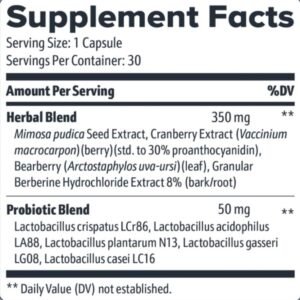
FemiCore Supplement Facts label reviewed for this article.
Unlike some bladder supplements that focus mainly on cranberry, FemiCore combines four herbal ingredients with five probiotic strains.
That probiotic component is what makes the formula particularly interesting.
FemiCore Ingredients
The current Supplement Facts label lists:
Herbal Blend: 350 mg
- Mimosa pudica seed extract
- Cranberry extract (Vaccinium macrocarpon), standardized to 30% proanthocyanidins
- Bearberry (Arctostaphylos uva-ursi) leaf
- Berberine hydrochloride extract
Probiotic Blend: 50 mg
- Lactobacillus crispatus LCr86
- Lactobacillus acidophilus LA88
- Lactobacillus plantarum N13
- Lactobacillus gasseri LG08
- Lactobacillus casei LC16
Something I like is that FemiCore gives the strains for its probiotics rather than merely listing the bacterial species.
This matters because probiotic effects can be strain-specific. NIH explains that probiotics are identified by genus, species and strain.
That said, one drawback is that FemiCore does not tell us how much of each ingredient is present.
That makes comparing the amounts with those used in clinical trials difficult.
How Is FemiCore Supposed to Help Bladder Leakage?
FemiCore’s main theory involves the urinary microbiome, sometimes called the urobiome.
Researchers now know the female bladder contains communities of microorganisms, and those bacterial communities appear to differ in some women who experience urinary incontinence.
That part of the FemiCore story has scientific support.
The unanswered question is whether taking FemiCore can alter those bacteria enough to improve bladder control.
Do the Probiotic Strains in FemiCore Help Bladder Control?
There is no direct clinical proof yet. I searched for the five specific probiotic strains listed in FemiCore. I could not find a human clinical trial showing that LCr86, LA88, N13, LG08 or LC16 reduces urinary leakage or improves bladder control.
That doesn’t mean the probiotic idea doesn’t work.
A 2024 study of 126 women found that those with more Lactobacillus in their urinary microbiome had fewer total and urgency-related leakage episodes. Women with less Lactobacillus had about 2.7 more total leaks and 1.8 more urgency leaks per day. That’s good news for FemiCore, but keep in mind this was an association and didn’t prove probiotics help incontinence.
Two FemiCore strains also have human research for other purposes. LCr86 has been studied for vaginal microbiome health, and LG08 has been tested in a randomized trial involving metabolic and gut-microbiome outcomes. Neither study, though, measured bladder control.
Bottom line: The idea that Lactobacilli may be connected to bladder health has scientific support, particularly for urgency-related leakage. What still needs to be studied is whether swallowing FemiCore’s probiotic strains restores the urinary microbiome and reduces bladder leaks.
Stress vs. Urge Incontinence: This Could Matter
One problem with advertising something simply as a “bladder control” supplement is that bladder leakage does not have a single cause.
ACOG divides urinary incontinence in women into three major categories.
| Type | What it usually looks like |
|---|---|
| Stress incontinence | Leakage while coughing, laughing, sneezing, or exercising |
| Urgency incontinence | Sudden powerful urge to urinate followed by leakage |
| Mixed incontinence | A combination of stress and urgency symptoms |
We need more research to determine if a microbiome supplement is equally effective for every form of bladder leakage.
Have FemiCore’s Probiotic Strains Been Studied for Bladder Control?
Not yet, at least not in human clinical trials that I could find. I did not locate a study showing that FemiCore’s five specific probiotic strains reduce urinary leakage or improve bladder control.
But that does not mean these probiotics cannot help.
There is a scientific reason to be interested in them. Research in women with urinary incontinence has found that urinary microbiomes containing more Lactobacillus bacteria are associated with fewer bladder leaks, particularly leaks related to sudden urinary urgency.
In one 2024 study, women with fewer Lactobacilli had about 3 more bladder leaks per day, including nearly 2 more leaks related to urinary urgency.
Some of the specific strains in FemiCore have also been studied in people for other microbiome-related purposes. For example, Lactobacillus crispatus LCr86 has been studied for vaginal microbiome health, while Lactobacillus gasseri LG08 has been tested in human probiotic research.
What researchers have not yet tested is whether taking these strains by mouth can change the urinary microbiome enough to improve bladder control.
Bottom line: There is a reasonable scientific basis for studying Lactobacillus probiotics for bladder health, especially urgency-related leakage. FemiCore’s particular strains are promising enough to be interesting, but clinical trials are still needed to know whether they actually reduce bladder leaks.
How Many CFUs Are in FemiCore?
We don’t know.
This is one of the biggest unanswered questions I have about FemiCore.
The Supplement Facts label lists: Probiotic Blend: 50 mg
It does not provide a CFU count.
CFU stands for colony-forming unit and is commonly used to describe the amount of viable bacteria provided by a probiotic product.
FemiCore tells us the five-strain blend weighs 50 mg, but that does not tell us how many microbes are present.
I would like to see FemiCore add a CFU count to the label.
Does Cranberry Help Bladder Leakage?
Cranberry is probably FemiCore’s best-known urinary-health ingredient.
There is legitimate human research on cranberry and urinary health.
The strongest evidence concerns recurrent urinary tract infections, not ordinary urinary incontinence.
According to the National Center for Complementary and Integrative Health, cranberry products may lower the risk of recurrent symptomatic UTIs in some women. Cranberry is not recommended as a treatment for an existing UTI.
Researchers believe cranberry proanthocyanidins may make it harder for certain bacteria to attach to the bladder wall.
That is useful urinary-tract research. But preventing a UTI is different from stopping urine leakage.
What About Mimosa Pudica?
FemiCore lists Mimosa pudica seed extract as the first ingredient in its herbal blend.
The company’s reference page cites a 2022 in-vitro study examining antioxidant and antimicrobial effects of Mimosa pudica.
That’s a laboratory study and not an incontinence-related human clinical trial
So there is some interesting laboratory research here, but human bladder-control evidence appears much thinner.
Does Berberine Help Bladder Control?
FemiCore’s references include a study suggesting berberine can affect bladder-muscle contraction.
And it might in rats with diabetes.
Berberine does have considerably more human research for metabolic conditions, but that does not automatically translate into bladder-control benefits. I wish there was more research on berberine and bladder control.
If you take blood sugar-lowering medications, speak with your doctor before taking berberine supplements.
Does FemiCore’s Dioxin Explanation Hold Up?
This is one of the more unusual parts of FemiCore’s marketing.
FemiCore’s official website says it addresses bladder health by targeting toxic dioxins that can disrupt the urinary microbiome and contribute to bladder leakage.
Dioxins are environmental pollutants can affect microbiomes.
For example, one FemiCore reference examines the effects of the dioxin-like compound PCB-126.
The dioxin explanation is an interesting possibility, but researchers are still working out whether dioxin exposure can alter the urinary microbiome in ways that contribute to urgency-related bladder leakage.
Has FemiCore Itself Been Clinically Tested?
I searched for a published human clinical trial testing the FemiCore formula.
Research supporting FemiCore currently comes mainly from studies on the urinary microbiome and its individual ingredients. I could not locate a published human clinical trial testing the complete FemiCore formula for bladder leakage.
That does not mean the formula cannot be helpful. It means researchers have not yet directly tested the finished product in a controlled clinical trial.
FemiCore Side Effects and Safety
Nothing on the FemiCore label immediately raises a major safety concern for most healthy adults. However, a few ingredients deserve a closer look, especially if you take medications or have certain medical conditions.
Berberine
Common side effects may include nausea, diarrhea, and bloating.
Berberine can also interact with medications, so talk to your doctor or pharmacist if you take prescription drugs.
Berberine should also be avoided during pregnancy and breastfeeding because of potential risks to the baby.
Bearberry
Bearberry may cause nausea, vomiting, and stomach pain. The European Medicines Agency also says women with kidney disorders should not use the bearberry leaf preparations
Other Precautions
As with most dietary supplements:
- Tell your doctor about FemiCore if you are scheduled for surgery.
- Do not use FemiCore during pregnancy or breastfeeding without discussing it with your doctor.
- Keep FemiCore out of reach of children.
Is FemiCore FDA Approved?
The FDA does approve supplements for safety and effectiveness before they are sold.
While FemiCore’s label says the product is made in an FDA-registered facility, this does not mean the agency has approved the facility’s products.
FemiCore Reviews and Complaints: What Can We Verify?
The FemiCore website says its customer rating is based on 19,263 reviews.
That’s encouraging to see, but I could not independently verify where those reviews came from or how the number was calculated.
That doesn’t mean the reviews don’t exist. They may come from customer feedback or internal records that are not publicly available.
How Much Does FemiCore Cost?
When I went through the current FemiCore checkout, I found three buying options.
| Price | Price per bottle | Shipping | Checkout total* | |
|---|---|---|---|---|
| 2 bottles | $158 | $79 | $9.99 | $167.99 |
| 3 bottles | $207 | $69 | Free | $207 |
| 6 bottles | $294 | $49 | Free | $294 |
*Prices shown when I checked. Always confirm the final checkout total before buying.
Since each bottle contains a 30-day supply:
- two bottles provide about 60 days
- three bottles provide about 90 days
- six bottles provide about 180 days
The six-bottle package has the lowest cost per bottle.
However, I would read the refund section below before deciding how many bottles to buy.
See Current FemiCore Prices & Packages
Is FemiCore a Subscription?
No. FemiCore does not require an automatic subscription or autoship program.
The company says purchases are one-time orders, so you are not automatically enrolled in monthly shipments.
I like this. When you finish your supply, you decide whether you want to order again rather than having another shipment automatically sent and charged to your card.
That helps avoid the recurring charges that sometimes come with supplement subscription programs.
FemiCore 60-Day Money-Back Guarantee: Read This First
FemiCore offers a 60-day refund period.
The company says the 60 days begin when your package is delivered.
The refund policy also says:
- contact FemiCore support
- return all bottles, even empty ones
- include the packing slip
- you pay the return shipping
- refunds are processed after the return arrives
So don’t throw away any of the bottles or your order information until you know you plan on keeping it.
Something else to keep in mind
FemiCore recommends giving it at least three months before deciding whether it works.
This is more than the 60-day refund window.
It may take some time to decide whether FemiCore is helping you. However, if you are not happy with your results and want a refund, don’t wait three months to make that decision.
Does FemiCore Charge Shipping?
The website shows these shipping charges at checkout:
- 2 bottles: $9.99 shipping
- 3 bottles: free shipping
- 6 bottles: free shipping
However, FemiCore’s separate shipping-policy page lists U.S. shipping as free.
When I checked the two-bottle order, the checkout added $9.99 shipping.
So look at the final total before submitting your order.
Where Can You Buy FemiCore?
I did not see this supplement sold in stores but if you want the same FemiCore formula reviewed in this article, I would use the ClickBank-linked FemiCore offer rather than buying from an unrelated website or marketplace listing.
During my research, I noticed several similarly named products and websites online, and I cannot verify that they all sell the same formula.
The link below takes you to the FemiCore offer associated with the product reviewed here.
Affiliate link. I may earn a commission if you purchase through this link.
FemiCore Pros and Cons
What I Like
- Five probiotic strains are identified by strain number.
- There is legitimate human research connecting the urinary microbiome with urinary incontinence.
- Cranberry is standardized to 30% PACs.
- FemiCore requires only one capsule per day.
- There is no automatic subscription. You reorder it when you like.
- Larger packages substantially reduce the price per bottle.
- A 60-day refund policy is available.
What I Would Like to See
- A clinical trial on FemiCore itself.
- Individual amounts for the four herbal ingredients.
- A CFU count for the probiotic blend.
- More research involving the exact probiotic strains and urinary incontinence.
- Better evidence supporting the dioxin explanation.
- Clearer information about long-term bearberry use.
- Consistent information about shipping and the refund period.
Who Might Consider Trying FemiCore?
I think FemiCore is most likely to appeal to a woman who:
- is interested in the emerging urinary microbiome research
- prefers a supplement containing both herbs and probiotics
- understands that the supplement has not yet been clinically proven
- is comfortable trying the product and judging her own response
- is willing to keep track of the 60-day refund deadline
I would be more cautious about assuming FemiCore will address leakage that clearly looks like stress incontinence, such as leaking during coughing or sneezing
Bladder leakage can also have many causes. Persistent or worsening symptoms deserve a proper medical evaluation rather than assuming a microbiome imbalance is responsible.
FemiCore Review: My Bottom Line
FemiCore is more interesting than I initially expected.
The idea that bacteria living in the urinary tract may be related to bladder symptoms has a legitimate scientific basis. Researchers have found meaningful differences in the urinary microbiomes of women with and without urinary incontinence.
I also like that FemiCore identifies all five probiotic strains rather than simply listing generic Lactobacillus species.
So I think the fairest conclusion falls somewhere in the middle.
FemiCore combines an interesting probiotic formula with several urinary-health ingredients, and there is emerging science behind the urinary-microbiome concept. What I would like to see next is a well-designed clinical trial showing whether FemiCore itself can reduce bladder leakage in women.
If you want to see how FemiCore works for you, the current six-bottle package offers the lowest cost per bottle.
See the Current FemiCore Offer Here
FemiCore Frequently Asked Questions
How long does FemiCore take to work?
I could not find a FemiCore clinical trial establishing how many days or weeks it takes to improve bladder symptoms.
I would therefore be cautious about websites promising a specific timetable.
If you try FemiCore, remember that its refund period lasts 60 days after delivery.
How many FemiCore capsules do you take?
The current FemiCore label recommends one capsule per day with water.
Each bottle contains 30 capsules.
What probiotics are in FemiCore?
FemiCore contains five probiotic strains:
- Lactobacillus crispatus LCr86
- Lactobacillus acidophilus LA88
- Lactobacillus plantarum N13
- Lactobacillus gasseri LG08
- Lactobacillus casei LC16
How many CFUs are in FemiCore?
FemiCore does not disclose the CFU count on the current label.
It lists the five-strain probiotic mixture as a 50 mg blend.
That makes it difficult to compare the dose with probiotic clinical trials.
What probiotics are in FemiCore?
FemiCore contains five probiotic strains:
- Lactobacillus crispatus LCr86
- Lactobacillus acidophilus LA88
- Lactobacillus plantarum N13
- Lactobacillus gasseri LG08
- Lactobacillus casei LC16
Is FemiCore safe?
I could not find a clinical safety trial of the FemiCore formula. The ingredients have different safety considerations. Berberine, in particular, can interact with medications and should not be used during pregnancy or breastfeeding. Anyone taking prescription medication should show the ingredient label to a physician or pharmacist before taking FemiCore.
Is FemiCore sold on Amazon?
The FemiCore product reviewed here is for the supplement at GetFemiCore.com
Because other products and similarly named websites may appear in search results, make sure the label matches the formula shown in this review before assuming it is the same product.
Does FemiCore have a money-back guarantee?
Yes. FemiCore currently provides a 60-day refund period from delivery. Remember to follow the return requirements, including returning all bottles.
Medical disclaimer: This article is for education only and is not medical advice. Urinary incontinence can have several causes. Speak with a qualified healthcare professional if you have new, persistent or worsening bladder-control problems.


Leave a Reply